
Vidéoscopes industriels are advanced inspection tools used to visualize and assess the internal conditions of inaccessible or hard-to-reach areas within industrial settings. Ils jouent un rôle crucial dans diverses industries, faciliter des inspections efficaces, entretien, et processus de dépannage. Cet article donne un aperçu des types courants de vidéoscopes industriels, leurs applications dans différentes industries, et spécifications importantes de l'équipement.
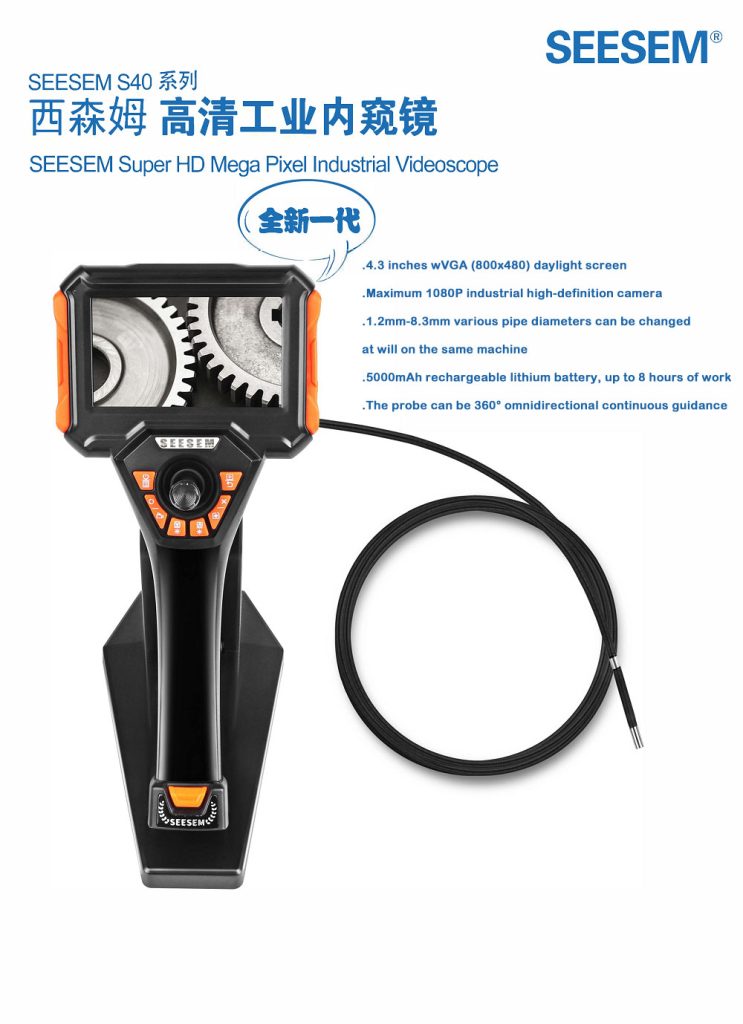
- Types of Industrial Videoscopes: Industrial videoscopes are available in different configurations and designs to suit specific inspection needs. The following are some commonly used types of industrial videoscopes:
un) Vidéoscopes rigides: Rigid videoscopes consist of a straight or articulated rigid probe, allowing direct insertion into cavities and pipes. They are ideal for inspections requiring precise control and offer high-resolution imaging. Rigid videoscopes find applications in industries such as aerospace, automobile, et fabrication.
b) Vidéoscopes flexibles: Flexible videoscopes utilize a flexible insertion tube, enabling navigation through curved or irregular pathways. They provide versatility in inspecting complex components and are commonly used in industries such as aviation, power generation, and plumbing.
c) Corscopes: Borescopes are long, tubular devices designed for inspections requiring access to narrow openings or deep recesses. They often feature optical or digital zoom capabilities and are widely used in industries such as oil and gas, pétrochimique, and automotive.
d) Articuler les vidéoscopes: Articulating videoscopes possess a flexible insertion tube with remote-controlled articulation capabilities. They allow the user to steer the probe tip, offrant une maniabilité améliorée et un accès aux zones d'inspection difficiles. Articulating videoscopes are commonly employed in industries such as aviation, electronics, and turbine maintenance.
- Applications industrielles: Industrial videoscopes have a wide range of applications across various industries, y compris:
un) Aérospatial et aviation: Videoscopes are utilized for inspecting aircraft engines, lames de turbine, et d'autres composants critiques, assurer l’intégrité et la performance des systèmes aérospatiaux.
b) Automobile: Videoscopes are used for engine inspections, cylinder bores, Injecteurs de carburant, et autres composants automobiles, aide au diagnostic, Contrôle de qualité, et maintenance préventive.
c) Fabrication: Videoscopes facilitate inspections of machinery, soudures, fonderie, et lignes de montage, permettant des contrôles de qualité efficaces, détection de défauts, et optimisation des processus.
d) Production d'électricité: Videoscopes play a vital role in power plants for inspecting boilers, éoliennes, échangeurs de chaleur, et tubes de condenseur, assurer l’efficacité opérationnelle et identifier les problèmes potentiels.
e) Petrochemical and Oil Refineries: Videoscopes assist in inspecting pipes, réservoirs, and vessels for corrosion, blocages, and structural integrity, enabling preventive maintenance and minimizing downtime.